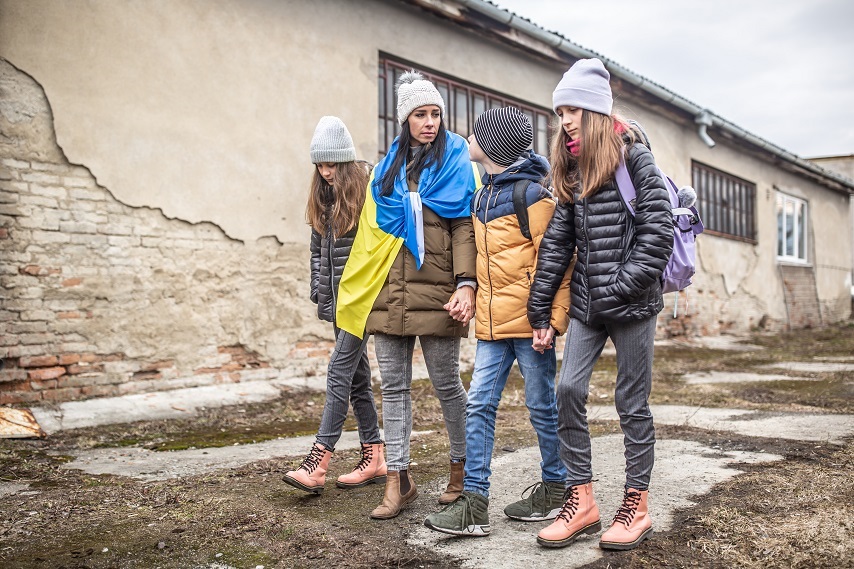
Ukrainian refugee families in Latvia had a great deal of flexibility regarding their preferred school model. HROMADA member Kata Fredheim, Viktor Pavlikha and Nataliia Pavlikha show how the choice of school affected the mothers, who often had to organise their children’s education, childcare, work and future plans all at the same time. Five key lessons can be drawn from this experience.
Latvia moved quickly to give displaced Ukrainians access to education after Russia’s full-scale invasion of Ukraine. Children could go to school. The harder question was what that schooling was for.
Was it meant to help families wait until return became possible? Or was it meant to help children and parents build a life in Latvia?
For many displaced Ukrainian mothers, this was not an abstract policy question. It shaped daily routines, children’s wellbeing, mothers’ ability to work or attend language courses, and family decisions about whether to prepare for return or for a longer stay.
Education and uncertainty in Latvia
After Russia’s full-scale invasion of Ukraine, Latvia received more than 40,000 displaced Ukrainians. By the end of 2023, 31,612 Ukrainians held temporary residence permits in the country. For Latvia, which had little previous experience of large-scale asylum inflows, this was a major test. The state responded quickly, granting Ukrainians legal residence status along with access to healthcare, employment, and education.
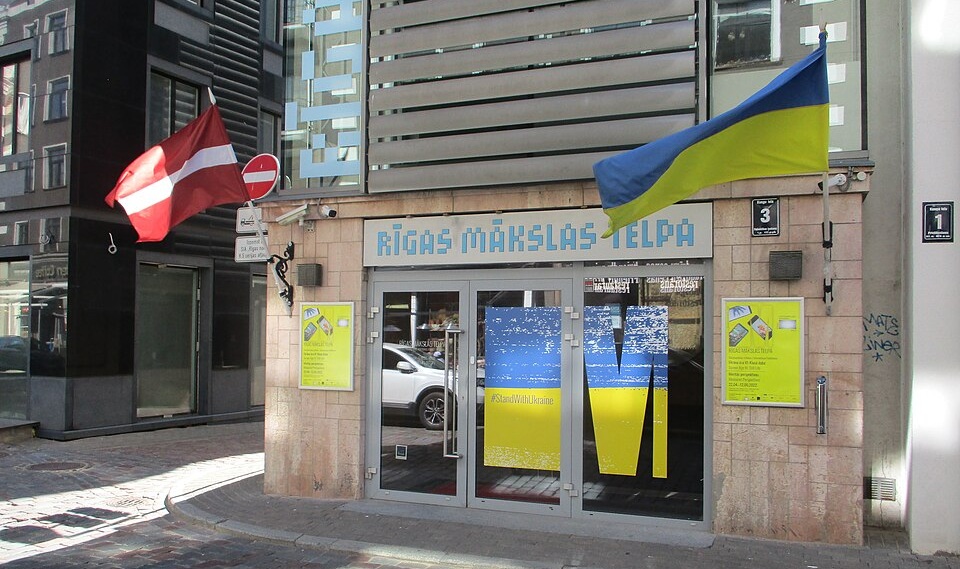
Education, however, raised a more difficult issue. Ukrainian children had the right to attend Latvian schools. But Latvia did not make attendance in the local school system compulsory. Families could choose Latvian schooling, Ukrainian online schooling, or some combination of both.
In the 2023/24 school year, around 62 per cent of school-aged Ukrainian children in Latvia were reported to be attending local schools. Among those who were not, 86 per cent were enrolled in Ukrainian online schooling. This online option gave families flexibility. It also left many of them to decide, with limited guidance, what kind of future they should prepare for.
An earlier HROMADA blog post looked at the experiences of Ukrainian pupils in Latvian schools. This piece looks at the same issue from another angle: how school choices affected mothers, who often had to organise their children’s education, care, work, and future plans at the same time.

The blog draws on a wider qualitative study of displaced Ukrainians in Latvia. Across three rounds of interviews in 2022-23, the research team interviewed displaced Ukrainians, including mothers with minor children, as well as people involved in education, such as lecturers and students. Interviews were conducted mainly in Ukrainian, including by Ukrainian speakers. Identifying details are not included here.
How the issue changed over time
In the first interviews, conducted soon after arrival, education was not the main concern. Mothers spoke mostly about housing, safety, food, documents and basic stability. These were the first needs of displacement.
By 2023, schooling had become much more important in mothers’ accounts. They spoke more often about children’s stress, tiredness, isolation and difficulty adapting. The question of education was no longer only about access; managing schooling had become part of everyday life for displaced families.
This shift matters. Latvia’s case is not mainly a story of exclusion. Ukrainian children were allowed to enter Latvian schools. Nor is it only a story of weak support. In many cases, schools, teachers and municipalities helped. The problem was that families were left to work out for themselves whether schooling was about waiting, returning, or settling.
What was specific to Latvia
Three factors made the Latvian case particular.
The first was language. Ukrainian children arrived in a school system that was itself moving more firmly towards Latvian-medium education. For Latvian policy, this was part of a wider national shift. For newly arrived Ukrainian families, it made school entry harder, especially for adolescents. They had to adapt to a new school, new classmates, a new curriculum and a new language of instruction.
The second was the role of Russian. Some Ukrainians had chosen Latvia partly because Russian was widely used in everyday life. This helped in the first period of displacement. It made shops, services and daily communication easier to manage. But it did not solve the school question. The main route through the Latvian education system increasingly ran through Latvian.
The third was local variation. Latvia is a relatively small system, and support depended heavily on municipalities, individual schools and particular teachers. Some families found helpful schools and teachers. Others faced gaps, delays or unclear information. Where a family lived, and whom they met, mattered a great deal.
This inconsistency also helps explain why voluntary schooling has been contested. Ukrainian organisations have often defended choice, because it protects family autonomy, keeps children connected to Ukraine, and leaves open the possibility of return. From the perspective of local integration, however, long-term optionality brings risks. Children may stay outside local peer networks. Mothers may be left supervising online schooling at home. The interviews suggest that many mothers were caught between these positions. They valued choice, but they also carried the cost of keeping several futures open.
What mothers described
The interviews point to three recurring problems.
The first was uneven adaptation. Younger children often adjusted more easily, especially when schools or preschools provided routine, structure, and contact with other children. Adolescents often had a harder time. One mother described trying to find Latvian language classes for her teenage child, only to discover that there were classes for small children and for adults, but not for those in between. This was not a small problem for the family. A child could be enrolled in school and still struggle to understand lessons.
At the same time, Latvian schooling was not described only negatively. For some mothers, especially those with younger children, school or preschool brought relief. One mother described how arrangements were quickly made for her children to attend kindergarten. Others spoke positively about teachers who helped children with Latvian, or about children who had made friends. These examples are important. They show that the problem was not local schooling as such. The problem was uneven support and the lack of a clear longer-term plan.
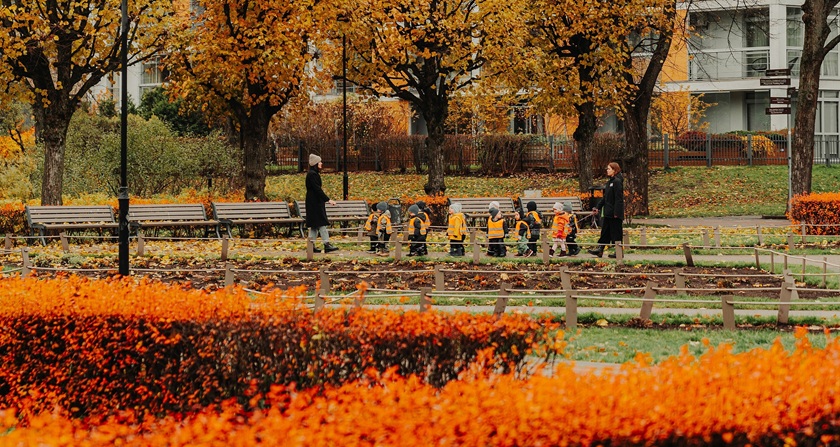
The second problem was overload. Many mothers tried to keep both options open. They wanted their children to adapt in Latvia, but they also wanted to preserve Ukrainian education, avoid losing a school year, and keep open the possibility of return. Balancing these two aspirations often meant dual schooling. A child could spend the day in school in Riga and then continue Ukrainian schooling online in the evening.
At policy level, this could look like flexibility. In family life, it often meant exhaustion. Children were tired. Days became long. Mothers had to manage two school systems, two sets of expectations, and two possible futures.
The third problem was that school choices became choices about the future. Latvian schooling pointed more clearly towards staying and adapting locally. Ukrainian schooling preserved language, curriculum and a route back into Ukraine’s education system. Mothers were therefore not only deciding where their children should study, but also what they should study. They were deciding what kind of future still seemed possible.
The interviews suggest three broad patterns. Where children attended Latvian school and adapted reasonably well, mothers said their days felt steadier, with more time to work or learn Latvian themselves. Where children stayed mainly in Ukrainian online schooling, mothers often had to sit with them and supervise their lessons, which ate into their own time. Where children split their time between Latvian school and Ukrainian online classes, families kept both options open, but usually paid for it in exhaustion and stress.
School, work, and who carries the cost
Schooling affected much more than children’s learning. It shaped whether mothers could organise daily life.
Where school or preschool worked predictably, mothers had more chance to work, look for work, or attend Latvian language and integration courses. Where children stayed at home for Ukrainian online schooling, needed help with Latvian schoolwork, were often ill, or had no care during holidays, mothers’ time became fragmented. The problem was not only that they had too little time. It was that they did not have reliable time.
This unreliability made work harder. It also made regular language courses harder. A mother could not easily accept shifts, attend classes, or plan ahead if the school day was uncertain, if online lessons required supervision, or if holidays left her alone with children.
The problem became especially visible outside the school year. Some mothers valued integration courses that explained education, healthcare, taxation and everyday life in Latvia. But general information did not solve practical problems. A lack of affordable summer activities, especially outside Riga, could leave mothers trying to work while also caring for their children full-time.
This pattern of unpredictable, unsupported time is why education policy cannot be separated from labour-market participation or wider inclusion. For displaced families, especially those in which women carry most of the care responsibilities, school is also time, routine, mobility, and income. A school place is not just a school place. It can decide whether a mother can participate in society, or only manage family survival from day to day.
Five things policy needs to get right
The lesson from Latvia is not that the state did nothing. It did a great deal quickly. The problem was that access was offered without enough clarity about purpose. Families were left to carry much of that uncertainty themselves.
The first need is clarity. If Latvian schooling is expected to support integration, this should be said clearly and reflected in support. Families should not have to guess whether local schooling is a temporary service during a waiting period or the main route into Latvian society.
The second need is stronger support for the Latvian language, especially for adolescents. Access to school means little if children cannot follow lessons. Older children need language support that fits their age and school level.
The third need is support around the school day. Preschool, after-school care and affordable holiday activities are not side issues. They make schooling workable for families. Without them, mothers’ ability to work or study Latvian remains fragile.
The fourth need is a more careful view of dual schooling. It may help in the short term, especially when families still expect to return. But over time it is hard to sustain. It can keep children connected to Ukraine, but it can also lead to tiredness, fragmented routines, and weaker local ties.
Finally, any move towards compulsory enrolment in Latvian schools needs to come with resources, teacher preparation and discussion with displaced families. Compulsion without support would only add pressure. The question is not only whether children are in Latvian schools, but whether those schools can help them learn, feel safe and build a daily life.
Conclusion
Temporary protection provided Ukrainians with quick legal access to safety, work, and services. But it said less about what should happen when temporary protection became less temporary. Education is one of the clearest places where this uncertainty appeared.
In Latvia, schooling was offered as a matter of access. For many mothers, it became something more difficult — a private responsibility to answer a public question. Namely, were their families waiting, returning, or beginning to settle?
Featured image: “Left Behind No More: Illustrations from Ukraine”, Credits: Dana Rvana (CC BY-NC 2.0)