A recent Providus study claims that the self-organisation and civic engagement of displaced Ukrainians are a unique phenomenon in Latvia, as the civic participation of newcomers here and elsewhere in Europe is otherwise fragmented. In this blog, HROMADA member Oksana Žabko provides insights into the diverse forms, motives, and resources of civic engagement among Ukrainians who have arrived in Latvia.
The Russia–Ukraine war has spurred a surge in various informal civic activities among both Latvian residents and Ukrainians who have arrived in Latvia. When the influx of people fleeing the war began, the Single Support Centre for Ukrainians – established in March 2022 – became the first stop for those seeking help. It brought together various government bodies under one roof and housed an NGO consultation desk offering help with essential supplies and household necessities. A team of volunteers managed the flow of people through the centre’s hallways, helped with paperwork, and provided other essential services. Here, Ukrainians could not only access the support they needed but also see local volunteerism in action.
After addressing their needs, some of the Ukrainians joined the centre’s team of volunteers or NGOs they learned about there. While the volume and scale of volunteer work have decreased in the coming years, some of these people have transitioned and continue to work at various Latvian NGOs. Others have established their own. This blog draws on interviews with displaced Ukrainians conducted as part of the ReCoM project in Latvia, as well as secondary sources on civic activities of migrants in Latvia. The empirical data suggest that the forms of civic engagement among Ukrainians are highly diverse and fluid, yet they are somehow linked to Ukrainians’ prior professional experience. Future insights, however, do not include volunteering to support soldiers on the front lines, even though this remains a significant goal of their activities.
Diversity in volunteers’ biographies
The experience of fleeing the war, leaving many loved ones behind, has sparked a desire to help, accommodate, and get involved. Thus, many of the displaced Ukrainians engaging with Latvian NGOs have no prior experience in such activities in their own country. However, they became familiar with civic activism in other ways. Some of them had worked in government or municipal institutions in Ukraine. Several possessed professional backgrounds in the social sphere, including, but not limited to, lawyers, teachers, and journalists. Some children were involved in sports activities; thus, some activists participated in cross-border collaboration initiatives in this field. Therefore, this last group had previous contact with Latvia even before the full-scale invasion began.
This prior experience allows Ukrainians to be more aware and to identify the niche or area of activity – a need of Ukrainians in the host and home countries that is not fully met by current provisions – and to get involved. For example, a teacher organizes native-language, literature and history classes for Ukrainian children living in Latvia; a young mother sets up flexible childcare services; a lawyer advises on the legal questions of staying in the country; and a former local government official builds contacts with Ukrainian municipalities, exchanges expertise on democratic governance to support EU integration, and runs summer camps for Ukrainian children. However, more sustained and stable activism requires space and recognition, and the experience of displaced Ukrainians demonstrates various solutions.
Two paths to self-organization
The first solution identified addresses local governments’ desire to offer targeted support to Ukrainians settled in their areas. Thus, several Latvian local governments (in cities such as Valmiera, Tukums, Kuldīga) have established a special position – Ukrainian community coordinator, held by any active representative of the community. The coordinators’ main tasks are to identify the community’s needs, advocate for their rights at the municipal level, and organize various cultural events. These include intercultural exchange with the host society. Coordinators believe that these events facilitate the integration of displaced Ukrainians in Latvia, while simultaneously allowing them to maintain their cultural identity and introduce it to locals. They also promote knowledge of Latvian history and culture, which Ukrainians were not very familiar with until they arrived. Activities include organizing joint events to celebrate Latvian and Ukrainian national holidays. At a more practical level, support for learning the Latvian language is also considered essential for helping children succeed in school and for adults to find jobs that match their skills.
The second solution proposed by several Ukrainians interviewed is to establish their own NGOs. It is important to note that it is not an entirely new form of Ukrainian self-organization in Latvia. Several NGOs founded by descendants of Ukrainians who arrived in Latvia during the Soviet era exist in Latvia upon the arrival of the newcomers of 2022, but the latter frequently choose to keep a distance. Moreover, although initially joining Latvian NGOs supporting refugees, the Ukrainians subsequently moved beyond that. According to a report by Providus, 14 NGOs founded by displaced Ukrainians were operating in Latvia at the end of 2025.
This solution became successful due to several factors. First, both the rapid familiarity with Latvian NGOs supporting refugees and their own prior professional experience ensured the swift consolidation of the community, the identification of needs, and the acquisition of local expertise to complete the legal procedures required to establish an NGO. The initial impetus was also supported by a mentoring system for emerging Ukrainian organizations, established by national NGOs. Second, Latvian government agencies supporting the NGO sector through project grant funding offered targeted programmes aimed specifically at facilitating Ukrainian civic engagement. Third, more experienced displaced Ukrainians felt a desire for autonomy in their ideas and activities – to be the leaders of their own projects rather than merely participate as volunteers or employees in local NGOs’ activities. Obtaining legal status was also a precondition for the stability of daily activities, advocacy of interests and fundraising. Despite the variety of everyday activities, their overarching goal is to maintain cultural identity and mutual support among displaced Ukrainians while they are staying in Latvia.
Engagement in debates on schooling of Ukrainian children in Latvia
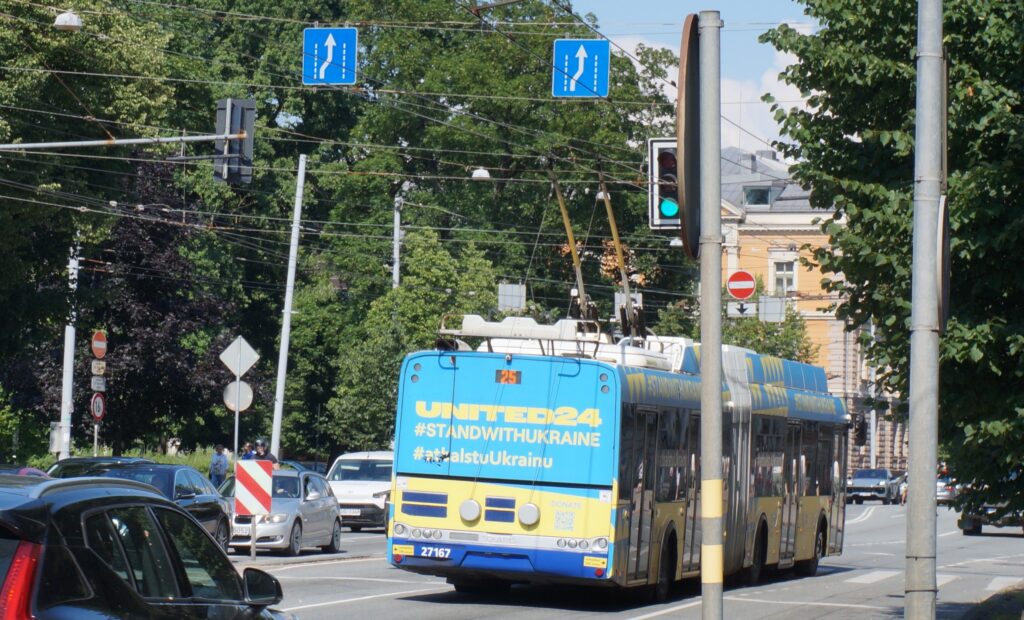
The most visible activities and examples of how Ukrainian NGOs represent the Ukrainian voice – its culture and needs – in Latvian society are their participation in various discussions and working groups on decisions affecting the community. Importantly, Ukrainian NGOs have rapidly gained influence and demonstrate their strength by engaging in discussions at both the municipal and national levels. The most crucial issue here was the debate over the education of Ukrainian children, still depending on the decision of their parents. When discussing a legislative initiative to make it mandatory for Ukrainian children to enrol in Latvia’s education system, Ukrainian NGOs supported the existing voluntary enrolment. The main argument behind this position was that the existing system allowed children to continue their studies online at Ukrainian schools, supplemented by Ukrainian literature and history classes organized by activists themselves. Although the Ukrainian-founded NGOs advocate this position, referring to the need to create a familiar language and customs environment for the children to mitigate the effects of their post-traumatic war experiences, this argument simultaneously raises concerns about the community’s tendency to isolate itself rather than integrate into the host society.
Obstacles in sustaining activities
However, despite this visibility in Latvian society, representatives of Ukrainian NGOs note that it is difficult to sustain the initial level of their activity and community interest, driven by several converging factors. First, as the community’s needs become less urgent and its numbers shrink, demand has shifted: consultations, particularly on legal matters, can now be obtained via social media, including Telegram and other channels. Second, state and local government support for Ukrainian NGOs has narrowed; these organizations must now compete on equal footing with all other organizations in a single grant competition, while securing international and private funding remains complex and time-consuming. Third, funding won through this competitive process comes with its own burden, requiring regular accounting in line with national law, a demand that strains organizations already stretched thin. Under these pressures, Ukrainian NGOs have begun to compete with one another, drift apart, and lose their shared sense of unity. Finally, experts in the NGO field acknowledge that Latvia cannot assume Ukrainian civic engagement will remain at its current level indefinitely. The two main threats are a continued decline in financial support and an erosion of the community itself, as both its leaders and ordinary Ukrainians relocate elsewhere or return home.
Is Ukrainian knowledge transfer possible to other migrant communities?
Alongside displaced Ukrainians, Latvia is also home to people from various non-EU countries who have arrived in the country for asylum, family reunification, study, or work. Although Latvian government institutions would like to engage these communities in more active dialogue and view NGOs as platforms for advocacy on migrants’ needs, there are almost no other organizations founded by newcomers. Therefore, the pressing question is whether the experience of Ukrainian civic engagement can be transferred to other communities. The authors of the Providus report published in 2025 believe that the Ukrainian experience is unique – it was a massive influx of migrants over a short period, which created similar needs and enabled the community to consolidate. Many of the displaced Ukrainians had higher education and shorter or more pronounced experience in related activities, such as work in governmental or municipal institutions, organizing events, or volunteering, and thus had a better understanding of NGO work. Transfer of this experience would be challenging. Migrants from non-EU countries might have completely different views on the criteria for self-organization, authority, and hierarchies in society, as well as on the objectives and operating principles of NGOs. Furthermore, Latvia’s experience shows that targeted support from national and local governments – tailored to the community’s needs and resources – is also an essential prerequisite for civic engagement of newcomers.
This work is supported by the research “Reception of migrants under conditions of uncertainty: governance and local level inclusion” (ReCoM) funded by the Latvian Council of Science (grant number: LZP-2023/1-0227). The author acknowledges Hanna Palii’s contribution in conducting the interviews.
Further reading:
[1] https://providus.lv/wp-content/uploads/2025/06/UkrainuNVOpetijums_gala_mazaks-compressed.pdf (in Latvian)
[2] https://miok.lviv.ua/wp-content/uploads/2026/04/zvit_doslidzhennya_latviya.pdf (in Ukrainian)