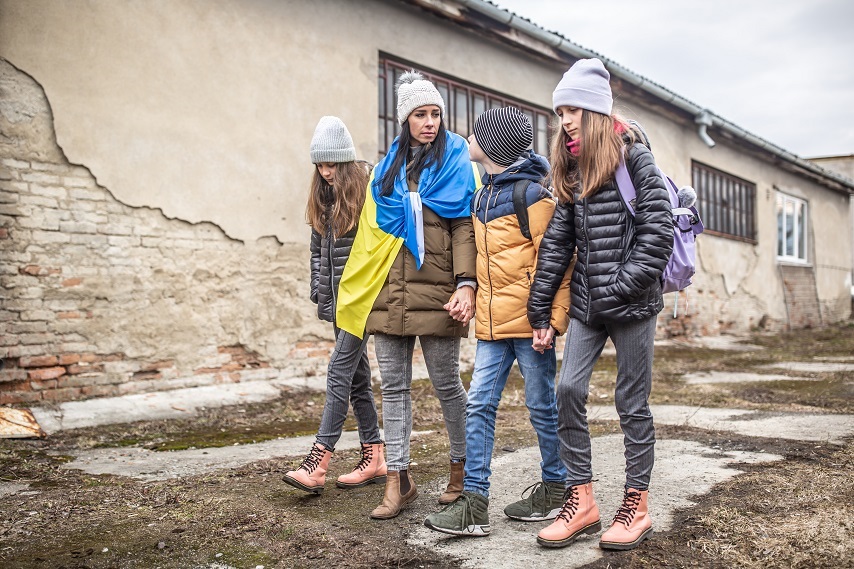
Young Ukrainians in Latvia find themselves caught between two education systems, two languages and two competing visions of the future. HROMADA member Hanna Markova shows that, in the context of forced migration, their educational choices represent strategies for coping with long-term uncertainty.
Ukrainian youth in Latvia find themselves between two education systems, two languages, and two visions of the future. In this blog post, I show that educational choices in the context of forced migration are not merely academic decisions. Rather, they are strategies for navigating long-term uncertainty. I use the term permanent temporariness to describe a condition in which displacement is formally temporary but, in practice, becomes prolonged and begins to shape everyday decisions about schooling, belonging, and future orientation.
| Note on data and methods This article is based on my ongoing doctoral research on the educational trajectories and integration of Ukrainian refugee youth in Latvia. It draws on qualitative fieldwork conducted in Latvia between December 2025 and March 2026, including two focus groups held in Riga with parents of forcibly displaced Ukrainians whose children are outside the formal Latvian school system (ten participants in total). The participants represented different localities, including Riga, Ādaži, Bauska, and Ogre. The article also draws on three in-depth interviews with parents, as well as on focus groups conducted with colleagues within the project Reception of migrants under conditions of uncertainty: governance and local-level inclusion (ReCoM, project No. LZP-2023/1-0227) at the University of Latvia. In addition, it builds on Latvian policy documents, secondary literature, and statistical sources. |
Education in a State of Permanent Temporariness
Since 2022, Latvia has accepted tens of thousands of Ukrainians under the Temporary Protection Directive. According to Eurostat, as of 1 November 2025, 31,410 people were registered under temporary protection in the country. At the same time, available Latvian data show that educational participation is far more difficult to interpret than these aggregate figures suggest. According to the Ministry of Education and Science of Latvia, as of 3 March 2025, 1,218 Ukrainian children were registered in preschool education, 2,625 in general education, 174 in vocational education, and 406 Ukrainian civilians in higher education institutions. Yet these figures show access and participation rather than trajectories and outcomes.
At first glance, the temporary protection framework provides safety and access to education. However, over time, temporariness ceases to be a short phase and becomes a long-term condition — a permanent temporariness if you will. This refers not simply to a feeling of uncertainty, but to a structural social condition in which families avoid making irreversible commitments and instead seek to preserve multiple future options simultaneously. This hedging behavior directly shapes educational decisions, including whether to remain in parallel education or postpone fuller integration into the Latvian school system.

This uncertainty is reinforced by the broader European policy context. Temporary protection in the EU is currently guaranteed until 4 March 2027, while public discussions about what should follow after that date have already begun. In this sense, “temporary” protection is repeatedly extended and politically deferred, further contributing to a prolonged condition of uncertainty for displaced families.
Two Waves of Migration: 2014 and 2022
To understand the current situation, it is important to distinguish between two waves of Ukrainian migration.
The migration after 2014, following the annexation of Crimea and the war in Donbas, had a mixed character, combining forced displacement with economic and educational motivations. Although this displacement was also deeply disruptive, it more often allowed for gradual reorientation, longer decision-making horizons, and step-by-step adaptation.
The wave after 2022 is fundamentally different: sudden, large-scale, and highly traumatic. Decisions to leave were often made under immediate threat, accompanied by the loss of home and profound uncertainty. Educational pathways in this context are formed after displacement, without a clear planning horizon.
Liminality as the New Normal
The experience of Ukrainian youth in Latvia can be understood through the concept of liminality, originally developed by Arnold van Gennep and later expanded by Victor Turner as a condition of being “in between” established social positions and institutional orders. In this article, liminality is understood not as a short transitional phase, but as a prolonged structural condition. Ukrainian young people in Latvia are suspended between two education systems, two languages, and two competing visions of the future. Rather than moving from one stable system to another, they must constantly navigate multiple institutional logics under conditions in which neither return nor permanent settlement can be taken for granted.
Parallel Education and “Invisible Children”
One of the defining features of the Latvian case is parallel education. According to Providus and related administrative data, in April 2025, 6,130 Ukrainian civilians aged 5–17 were registered in Latvia, but only 3,806 were enrolled in Latvian preschool and Grades 1–12. This leaves an estimated 2,324 school-age children outside the Latvian education system.
Those who participate in both systems face double workloads, extended school days, and very limited time for social interaction. Education thus becomes not primarily a tool of integration, but a way of keeping multiple future pathways open.
As one focus group participant explained: “We don’t know how long we will stay, so it is hard to understand which education is ‘right’.” Another said, “My child studies in both systems just in case, so we don’t lose any opportunities.”
This dynamic is shaped not only by family uncertainty but also by the coexistence of two policy frameworks. While Latvia emphasizes inclusion in its own system, Ukrainian educational policies actively support maintaining a connection to Ukrainian schooling and future reintegration. Families, therefore, navigate between two overlapping institutional logics.
Policy Changes: Formal Inclusion in the System
In response to these challenges, Latvia has begun to further develop and coordinate its approach to the education and inclusion of Ukrainian civilians. Recent policy discussions and coordination efforts, including through the TAP portal, point to a stronger emphasis on participation in Latvian educational institutions and improved institutional oversight. At the same time, this policy direction is still evolving and is being implemented gradually rather than as a single rigid model. Parallel education is therefore unlikely to disappear soon, and many families will continue combining both systems.
Language as an Institutional Barrier and Limited Social Integration
Language remains one of the main barriers. The transition to Latvian as the language of instruction creates significant challenges, especially for adolescents. Limited proficiency affects both academic performance and social participation.
Formal enrolment does not equal real integration. Students may be physically present in the classroom but excluded from informal communication and peer relationships. Parallel education exacerbates this by leaving almost no time for extracurricular activities or social bonding. The lack of teacher assistants and support staff further limits social inclusion.
Choice After Grade 9: Adaptation Rather Than Strategy
The transition after Grade 9 is a critical turning point. Students must choose between general secondary and vocational education. This choice is heavily influenced by the family’s economic situation and overall uncertainty about the future.
Available data suggest participation in different educational levels, but they do not show trajectories. As of 3 March 2025, 174 Ukrainian young people were registered in vocational education, and 406 Ukrainian civilians were enrolled in higher education institutions. Publicly available data still do not show how many Ukrainian students complete Grade 9 in Latvia, how many continue to upper-secondary education, how many enter vocational tracks, and how many remain in parallel or interrupted educational pathways.
Vocational paths may offer quicker access to income but often lead to reduced long-term educational opportunities. Decision-making here becomes a form of adaptation to constraints rather than a strategic investment in the future.
Pragmatics of Belonging
For many young people, belonging to Latvia is pragmatic rather than emotional. They participate in the Latvian system and make short-term plans in the host country while maintaining strong emotional ties to Ukraine and keeping return as a possible future project. Belonging is thus negotiated through everyday educational decisions and family strategies.
Conclusion
For Ukrainian displaced youth in Latvia, education is the space where fundamental questions are negotiated: where to live, which system to commit to, what to invest in, and what kind of future is possible. Living between systems is no longer a temporary phase. It has become a new social condition that shapes identities and life trajectories. These experiences, therefore, call for an analytical shift — from the language of access and inclusion toward a broader sociology of uncertainty, temporariness, and negotiated belonging.