This post by Ruslana Moskotina and Valentyn Hatsko is adapted from the Ruslana’s VoxUkraine column, which extends the earlier work by Klimak and Vlandas (2024) on whether wars abroad affect attitudes at home. Based on their analysis, the authors offer seven recommendations for policymakers and civil society actors in the Nordic–Baltic region.
We know a great deal about how the war has reshaped Ukrainian society, but does the war also affect the worldview of people beyond Ukraine’s borders? How has it changed Europeans across the continent, including in countries that are neither EU members nor neighbours of Russia or Ukraine?
Earlier research has already captured what might be called a “first shock” effect. Klimak and Vlandas analysed European Social Survey (ESS) data across eight countries and found that in the weeks following the full-scale invasion in February 2022, support for democracy strengthened, authoritarian leanings weakened, and emotional attachment to Europe grew. Positive views on EU enlargement and positive evaluations of immigration’s impact on the economy and culture also spiked, but only briefly, returning to pre-war levels by April 2022.
That earlier work, however, only covered the first 60 days after the invasion. It showed that some changes were immediate reactions, while others (such as growing attachment to Europe) took longer to appear. But what happens in the medium and long term? With fresh data from the 11th wave of the ESS covering 2023–2024 now available, we can finally assess this.
Data and approach
The study uses data from the 10th (2020–2022) and 11th (2023–2024) waves of the ESS across ten countries where face-to-face interviews in the ESS round 10 spanned periods both before and after the full-scale invasion: Belgium, Switzerland, the United Kingdom, Greece, Ireland, Italy, Montenegro, the Netherlands, Norway, and Portugal.
Eight attitude indicators were examined, split into two groups: political attitudes (emotional attachment to Europe, support for EU enlargement, views on loyalty to political leaders, demand for income redistribution) and attitudes toward migrants (willingness to admit people of different races or from poorer non-European countries, perceptions of migrants’ impact on the economy and cultural life). To track changes, responses were divided into six periods, ranging from before the invasion to 1.5 years and beyond, to capture short-, medium-, and long-term dynamics. The analysis pooled data from all ten countries and used regression models (a statistical technique that estimates how much each factor, such as the timing of the survey, contributes to a given attitude while holding other factors constant). This made it possible to control for individual characteristics such as age, education, and income, and to separate the effect of when a person was surveyed (before vs after the invasion, and how long after) from differences across countries. In other words, we can ask: setting aside that respondents in, say, Portugal and the Netherlands differ in many ways, did attitudes shift after February 2022 once those background differences are accounted for?
Table 1. The eight ESS attitude indicators analysed
| Group | Indicator | Survey question (abbreviated) | Response scale |
| Political attitudes | Emotional attachment to Europe | How emotionally attached do you feel to Europe? | 0 (Not at all) – 10 (Very emotionally attached) |
| Support for European unification | European unification should go further, or has already gone too far | 0 (Already gone too far) – 10 (Should go further) | |
| Loyalty to leaders | People should be loyal to their leaders, even when leaders are wrong | 1 (Agree strongly) – 5 (Disagree strongly) | |
| Income redistribution | Government should take measures to reduce differences in income levels | 1 (Agree strongly) – 5 (Disagree strongly) | |
| Attitudes toward migrants | Admitting different race/ethnicity | Allow people of a different race or ethnic group to come and live here | 1 (Allow many) – 4 (Allow none) |
| Admitting from poorer non-European countries | Allow people from poorer countries outside Europe to come and live here | 1 (Allow many) – 4 (Allow none) | |
| Economic impact of immigration | Immigration is bad or good for the country’s economy | 0 (Bad) – 10 (Good) | |
| Cultural impact of immigration | Country’s cultural life is undermined or enriched by immigrants | 0 (Undermined) – 10 (Enriched) |
Europeans want a bigger EU — but feel less European
The clearest long-term shift was in support for EU enlargement, which rose after the invasion and remained elevated across every time period, from the first month through 1.5 years and beyond. Europeans, it seems, have come to see a larger EU as desirable or necessary, and this view has proven durable.
Emotional attachment to Europe told a more complicated story. In the first one to three months after the invasion, it was significantly higher than pre-war levels. But by the 1.5-year mark and beyond, it had actually fallen below its level before February 2022. So Europeans increasingly support the EU as an institution worth expanding, yet feel less emotionally connected to Europe as an idea. This tension is one of the study’s most thought-provoking findings.
Views on political loyalty showed an interesting pattern as well. In the very first weeks, people became less inclined to agree that citizens should be loyal to their leaders (perhaps a reaction against authoritarian postures at a moment when an autocratic regime had just invaded a neighbour). But between three and six months later, that belief bounced back above its pre-war level. The demand for government action to reduce income inequality, meanwhile, remained essentially unchanged throughout.
Figure 1. Results of the regression analysis of changes in political attitudes after the invasion, compared to the period before February 2022.
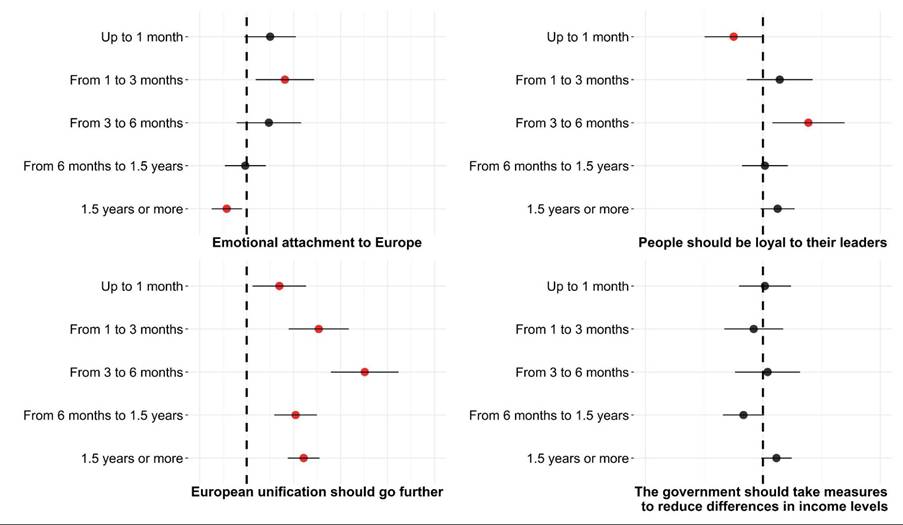
Note: Each dot shows the estimated change in a given attitude for a specific period after the invasion, compared to before February 2022. Dots to the right of zero mean attitudes became more positive; dots to the left, more negative. The horizontal lines show how confident we can be in that estimate: red dots mark changes large enough to be statistically meaningful, black dots mark changes small enough to plausibly be due to chance. Openness to migrants surged, then collapsed below pre-war levels.
The migration story is perhaps the most dramatic, and for Nordic–Baltic countries, where the debate over reception and integration of newcomers (whether labelled migrants, refugees, or temporarily protected persons) has been especially charged in recent years, arguably the most consequential. A note on usage: the ESS questions analysed here ask about immigrants broadly, so “migrants” in this piece refers to that general category. “Refugees” is used specifically for people displaced by the war, most of whom hold temporary protection status. Sweden’s sharp policy pivot from one of Europe’s most open asylum regimes toward significantly tighter controls, Denmark’s long-standing restrictive approach, and the broader Nordic reckoning with integration outcomes all form a backdrop against which these findings acquire particular urgency.
In the first month after the invasion, attitudes toward migrants across the ten countries were essentially the same as before the war. But a curious split appeared in the 1–3 month window: Europeans became more sceptical about migrants’ positive impact on the economy and cultural life, even though their willingness to admit newcomers didn’t decline. In other words, people were still open to migration in principle, but growing less convinced it was beneficial in practice.
Then came a period of warming. Between three and six months after the start of the full-scale war, three of the four migration indicators improved. Support for admitting migrants of different races grew. So did belief in migrants’ positive contributions to the economy and culture. The exception was willingness to admit people from poorer non-European countries, which remained at pre-war levels throughout.
But in the long run (1.5 years and beyond), attitudes deteriorated across the board and fell below pre-war levels. This is a sobering finding. Whatever solidarity or openness the early months of the war had generated, it not only dissipated but reversed, leaving European publics less favourably disposed toward migrants than they were before Russia’s invasion.
Figure 2. Results of the regression analysis of changes in attitudes toward immigrants after the invasion, compared to the period before February 2022

Note: The dots represent regression coefficients, and the horizontal lines represent their 95% confidence intervals. Statistically significant differences compared to the pre-invasion period are shown in red, while non-significant differences are shown in black. Points to the right of the vertical dashed line (zero) indicate more positive attitudes after the invasion, while points to the left indicate more negative attitudes.
Compassion fatigue, disinformation, and a desire for normalcy
So what explains these patterns, particularly the divergence between durable support for EU enlargement and declining emotional attachment to Europe, or the reversal of initial pro-migrant sentiment?
On migration, one plausible interpretation is that general attitudes toward immigrants partly reflect perceptions of Ukrainian refugees specifically, even though the survey questions don’t single them out. In the early months, there was enormous sympathy: these were people fleeing a war that Europeans watched unfold in real time. But as the war dragged on without a resolution in sight, the framing may have shifted. Refugees initially seen as temporary guests in need of help began to be perceived as long-term residents who would compete for jobs and strain social services. At the same time, Russian information warfare that was deliberately aimed at destabilising European societies, including through the migration theme, should not be underestimated as a contributing factor.
The divergence between EU enlargement support and emotional attachment to Europe is more puzzling, but several explanations are plausible. The shattering of assumptions about a safe and predictable world may push people toward supporting EU enlargement as a geopolitical strategy, the logic of strength in numbers, of building a larger bloc to counter external threats. This is a rational, strategic calculation, and it doesn’t require emotional warmth toward “Europe” as an identity.
Meanwhile, disappointment with the EU’s perceived insufficient response to the war may be breeding scepticism and weakening the emotional bond. There may also be a simpler psychological mechanism at work: A desire for normalcy. In European media, the EU frequently appears in the context of sanctions, arms deliveries, and the Russia-Ukraine conflict. This constant association with stressful events could trigger an avoidance response, eroding a sense of belonging to a European community.
The Nordic–Baltic region can’t afford to wait — seven steps forward
The patterns documented here are clear and consequential. The war in Ukraine has left a measurable imprint on European public opinion, one that evolved from initial shock and solidarity into something far more complex. For policymakers and civil society actors in the Nordic–Baltic region, seven recommendations stand out.

- 1. Shift the narrative from solidarity to mutual benefit. The emotional boost from the first months of the invasion has not just faded but reversed. Communication strategies that still rely on the 2022 wave of empathy are working with an outdated assumption. Nordic–Baltic governments and organisations need to make the practical case: what Ukrainian refugees contribute to host labour markets, how integration investments yield returns, and why engagement with Ukraine serves regional security. Norway’s experience integrating Ukrainian refugees into its labour market offers concrete stories to tell. Sweden has deep institutional capacity in employment-oriented integration, but recent research suggests that restrictive policy choices under the Temporary Protection Directive have prevented this capacity from being fully deployed for Ukrainians, a gap that deserves attention. The appeal to solidarity still matters, but it can no longer carry the argument on its own.
- 2. Get ahead of the migration backlash with visible integration outcomes. The long-term decline in pro-migrant attitudes is a warning signal that resonates strongly in the Nordic context. The political space for anti-migrant narratives will only grow if governments cannot demonstrate that integration is working. For Nordic–Baltic countries hosting Ukrainian refugee populations, this means investing in transparent reporting on employment and education outcomes, scaling up language training, and accelerating credential recognition, areas where the Nordic countries have institutional capacity but where implementation has often been slow or uneven. Programs that connect refugees with local communities and employers, rather than concentrating them in isolated housing, are essential. The folkhögskola tradition in Sweden and the broader Nordic model of adult education offer ready-made infrastructure for refugee upskilling that other European countries lack.
- 3. Use Nordic–Baltic cooperation to build integration models that travel. The Nordic Council of Ministers and the Baltic Assembly are well-positioned to develop shared frameworks for refugee integration that draw on each country’s strengths. Denmark’s emphasis on early labour market participation, Sweden’s adult education infrastructure, Norway’s settlement dispersal model, and the Baltic states’ particular understanding of the Ukrainian context could be combined into transferable approaches. Given the EU’s ongoing discussions about the future of the Temporary Protection Directive and longer-term integration pathways for Ukrainian refugees, Nordic–Baltic countries have an opportunity to lead with evidence-based models rather than waiting for Brussels to set the terms.
- 4. Treat counter-disinformation as integration policy. The finding of this study that migration attitudes may be partly driven by Russian information campaigns has particular relevance in the Nordic–Baltic region, which sits at the frontline of Russian hybrid threats. Sweden’s Psychological Defence Agency (MPF), Finland’s comprehensive security model, and the Baltic states’ extensive experience with Russian-language disinformation are all assets. But these capabilities have largely been treated as security tools, separate from migration and integration policy. The data here makes the case for connecting them: if a hostile actor is actively manipulating public attitudes toward refugees, then shaping those attitudes is a matter of democratic resilience, not just public relations. The Nordic–Baltic region could pioneer this integrated approach.
- 5. Address the concerns of host communities directly. The ESS analysis confirms that scepticism toward migrants and inclinations toward authoritarian leadership are concentrated among economically vulnerable, rural, and less educated populations. In the Nordic context, these are often the same communities where refugees are settled through dispersal policies — smaller municipalities with fewer resources and weaker labour markets. Policy responses that frame refugee reception purely as a moral obligation, without addressing the material concerns of host communities, risk deepening the urban-rural polarisation that has already reshaped Nordic politics. Investment in public services, housing, and local job creation in receiving municipalities is not an add-on but a precondition for sustainable integration.
- 6. Strengthen the emotional case for European belonging. The finding that Europeans support EU enlargement strategically but feel less emotionally connected to Europe is a vulnerability, and for non-EU Norway and the Nordic–Baltic EU member states alike, this is the reminder that European identity cannot be sustained on security arguments alone. Nordic–Baltic cultural exchange programs, people-to-people initiatives with Ukraine, and visible investments in shared democratic values can help build the emotional foundation that strategic calculations alone cannot provide. The Nordic countries already have the institutions in place for this work: long-standing support for civil society, well-funded cultural exchange programs, and a track record of educational cooperation across borders. That existing infrastructure can be directed toward building ties with Ukraine and reinforcing a sense of shared European belonging, rather than being built from scratch.
- 7. For Ukraine: The case for European engagement must be made actively. International sympathy is not inexhaustible, and the trajectory suggests it is actively eroding. Ukrainian civil society, diaspora organisations, and government communicators need to engage Nordic–Baltic publics not just with the story of the war, but with the story of what comes after: reconstruction, reform, and economic partnership. The HROMADA network and similar platforms play a critical role in keeping this conversation grounded in evidence and oriented toward practical cooperation.
A note on limitations
These findings apply specifically to the ten countries studied and should not be automatically generalised to all of Europe. Most Nordic and Baltic countries are absent from the sample: Denmark did not participate in the 10th or 11th waves of the ESS at all, while Sweden, Finland, and the Baltic states participated, but their fieldwork did not straddle the February 2022 threshold as the methodology requires.
That said, Norway is in the dataset, and the trends identified here, particularly in migration attitudes and EU enlargement support, are consistent with dynamics across the Nordic–Baltic region. Changes in attitudes recorded after the invasion were not necessarily caused by the invasion; over the longer term, the war’s effects blend with energy crises, inflation, domestic politics, and other migration flows. And since different people were surveyed in different periods, what we observe are aggregate trends, not individual transformations.
Still, the direction is unmistakable. Understanding how European public opinion has evolved since February 2022 and where it might be heading is essential for anyone in the Nordic–Baltic region working to sustain the democratic solidarity that Ukraine needs and that Europe, ultimately, needs too.
Funding
This research was funded by the Swedish Institute Baltic Sea Neighbourhood Programme, grant number: 01221/2023. The first phase of data collection was supported by a grant from the International Renaissance Foundation and the Embassy of the Kingdom of Sweden in Ukraine, as part of the project “Ukraine in European Social Survey 2021” (signed on 15.11.2021).