Developing effective integration policies requires a clear understanding of Ukrainian migrants’ concerns and needs. In this blogpost, Nina Khairova presents an AI-based analysis of messages in public Telegram channels and communities supporting Ukrainians in 12 host countries. Contrasting the findings with governments’ communication, she finds differences between official priorities and the everyday concerns of Ukrainian migrants.
Since Russia’s full-scale invasion of Ukraine in February 2022, millions of Ukrainians have been forced to seek protection across Europe. European governments, international organisations and local authorities have introduced a wide range of measures to provide humanitarian assistance, legal protection and support for integration. However, developing effective integration policies requires not only government initiatives but also a clear understanding of Ukrainian migrants’ actual experiences, concerns and evolving needs.
Understanding Ukrainian Migrants’ Voices Through AI
Governments traditionally hear from different social groups through established channels such as the media, public consultations, social surveys and monitoring assessments, as well as more recent digital government platforms. These channels allow public institutions to gather information about citizens’ needs, understand public concerns and receive feedback on government policies. Displaced populations, however, are often under-represented in these channels. Language barriers, limited awareness of how to participate, and the difficulty of reaching newly arrived or less connected communities can keep migrants from making their views heard. As a result, their everyday experiences, concerns and changing needs may remain insufficiently visible to policymakers.
At the same time, social media platforms have become important spaces where migrants share information, discuss everyday challenges and seek support. Analysing these discussions can provide valuable insights that complement official statistics and surveys. By focusing on broader patterns rather than individual users, such analysis can reveal the concerns most frequently discussed, how they differ across countries and how they evolve over time.
Recent advances in artificial intelligence (AI) and natural language processing have opened new opportunities to understand public concerns by analysing large volumes of online communication. Social media messages are often short, multilingual, and unstructured, making them difficult to analyse systematically with traditional methods. AI-based text analysis can identify recurring themes across thousands of messages, recognise related issues expressed in different words and reveal how attention to particular concerns varies across countries and changes over time. Generative AI goes further, allowing researchers to move beyond individual topics to the broader ethical, legal and social dimensions reflected in public discussion.
However, identifying migrants’ concerns is only the first step. For integration policymaking, it is equally important to understand whether these concerns are reflected in the priorities expressed through official government communication. Examining this alignment raises two closely connected questions:
- To what extent do European governments’ priorities, as reflected in official communication, align with the actual experiences and needs of Ukrainian migrants across ethical, legal and social (ELS) dimensions?
- And how can we measure this alignment?
To explore these questions, our research draws on two complementary datasets, covering the period from February 2022 to 2025.
The first dataset contains 708 official documents from 34 information sources, including government portals, migration agencies, national ministries and the International Organization for Migration (IOM). These documents reflect institutional priorities, regulations and measures introduced to support Ukrainians displaced by the war.
The second dataset comprises more than 1.7 million messages from public Telegram channels and communities supporting Ukrainians in 12 host countries. These discussions provide insights into the everyday challenges, concerns and experiences shared within migrant communities. Together, the two datasets offer complementary perspectives on Ukrainian migration: how institutions communicated their policies and support measures, and how migrants discussed their needs and experiences. Comparing these perspectives allowed us to identify areas of alignment and divergence across ethical, legal and social dimensions.
Different Needs Across Countries and Changing Policy Priorities
The analysis of Telegram discussions revealed 12 recurring challenges Ukrainian migrants experienced across Europe. Nearly three-quarters of the discussions focused on five main concerns: housing and apartment rental (19.7%), passport and visa procedures (16.5%), refugee status and support from international organisations (15.9%), relocation and transportation (11.3%), and communication and access to information (10.1%).
As illustrated in Figure 1, the distribution of these challenges varied considerably across host countries, reflecting different circumstances and concerns within Ukrainian migrant communities. For example, housing was among the most frequently discussed issues in Germany and Sweden, while relocation and transportation dominated discussions in Poland. In the Czech Republic, passport and visa procedures and access to information were particularly prominent. Meanwhile, Ukrainian migrants in Sweden also frequently discussed language learning and taxation, highlighting concerns specific to their integration into Swedish society.
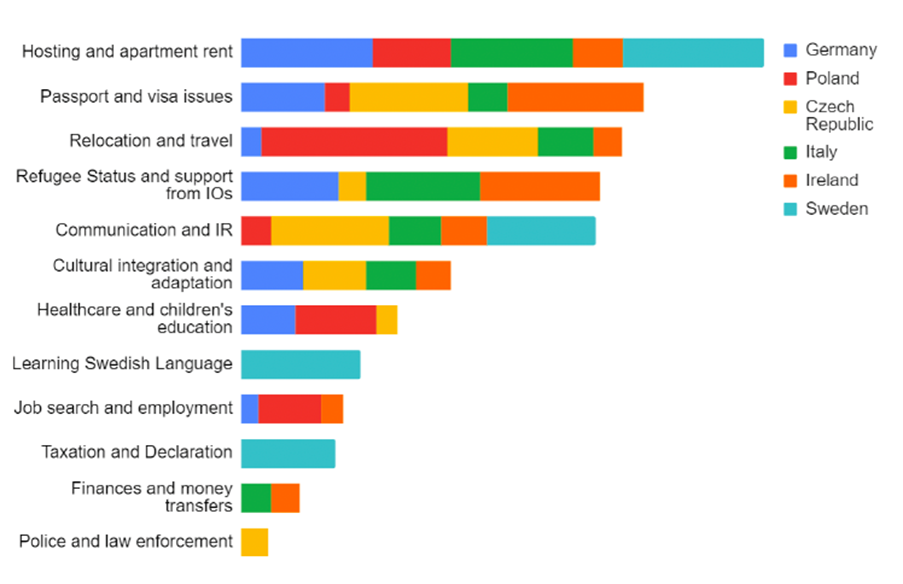
These differences show why integration policies cannot follow a one-size-fits-all approach. While Ukrainian migrants face many common challenges across Europe, their needs also depend on the circumstances in each host country. Moreover, these needs can change over time, requiring policies to adapt to new challenges and priorities.
Official government communication also changed over time. As Figure 2 shows, attention to Ukrainian migration issues was particularly high during the first months of the full-scale invasion in 2022, when humanitarian support and the impact of the war on Ukrainian citizens’ lives dominated official discussions. As the initial focus on emergency assistance declined, attention became more varied, covering displacement, documentation and administrative procedures. Issues related to displacement and documentation remained prominent throughout much of the analysed period, while European collaboration received greater attention in early 2023 and cross-border displacement became more visible in the second half of that year.
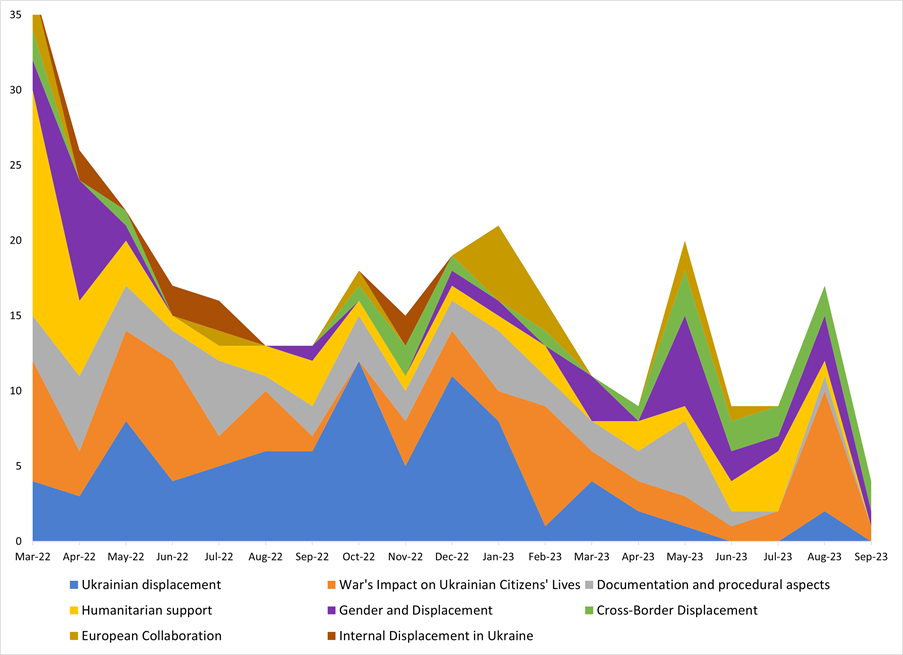
In 2024 and 2025, European migration policies increasingly shifted towards longer-term protection and integration. In 2024, the EU extended temporary protection for displaced Ukrainians until March 2026, recognising the continuing need for stability and support. By 2025, greater attention was being given to the social and economic integration of Ukrainians into host societies, including employment, education and participation in local communities. In 2025, the EU extended temporary protection until March 2027, and in July 2026 it extended it again, until 4 March 2028, while beginning to prepare a coordinated approach to the eventual transition to other residence statuses or voluntary return to Ukraine when conditions allow. These developments reflect a gradual shift in European policy priorities from immediate humanitarian assistance towards longer-term integration and legal stability.
Do Government Priorities Reflect Ukrainian Migrants’ Needs? An Ethical, Legal and Social Perspective
Social cohesion depends on more than whether governments and migrants give equal attention to the same practical needs. It also depends on whether their perspectives reflect shared values such as fairness, respect for human rights and the rule of law, and social inclusion. Examining how these values appear in official communication and in migrants’ discussions, and where the two align or differ, can help us understand how institutional priorities and Ukrainian migrants’ expectations bear on social cohesion.
To explore this relationship, we examined the same data through ethical, legal and social (ELS) dimensions, rather than focusing only on specific challenges such as housing, employment or documentation. As illustrated in Figure 3, this approach allowed us to compare the priorities reflected in official communication and migrants’ discussions. Using generative AI and a framework of 450 migration-related concepts, supported by expert validation, we identified how these dimensions were represented in both perspectives.
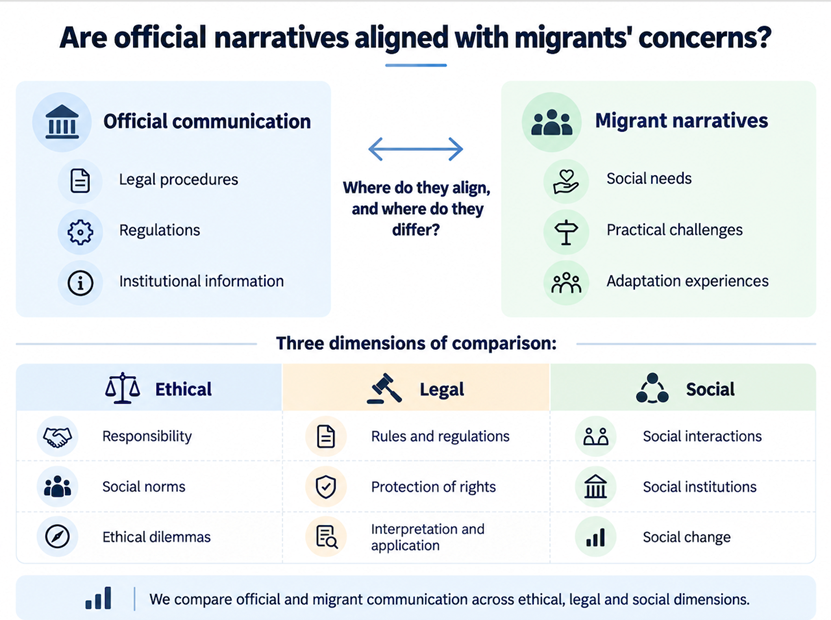
The analysis revealed both similarities and important differences between the two perspectives. Social issues dominated both official communication and migrants’ discussions, but accounted for 75% of migrant-related messages compared with 66.3% of official documents. While government communication focused mainly on institutional support, integration programmes and financial assistance, migrants’ discussions more frequently reflected everyday challenges related to housing, employment, language learning, healthcare and education.
In contrast, official communication paid more attention to legal issues (32.7%) than migrants’ discussions (22.8%). Government publications focused more on regulations, temporary protection and residence requirements, while migrants were primarily concerned with practical questions about documentation, administrative procedures and access to their rights.
As Figure 4 shows, these differences were not static but evolved over time. In official communication, the share of legal issues increased from 29.4% in 2022 to 37.7% in early 2025, while the share of social issues declined from 69.0% to 62.3%. This finding suggests that official communication gradually shifted toward the legal and administrative aspects of migration governance. By contrast, migrants’ discussions remained consistently centred on social concerns, which accounted for 75.4% of messages in 2022 and 74.5% in early 2025. This relative stability indicates that, despite policy changes, Ukrainian migrants remained primarily concerned with everyday practical and integration-related challenges.
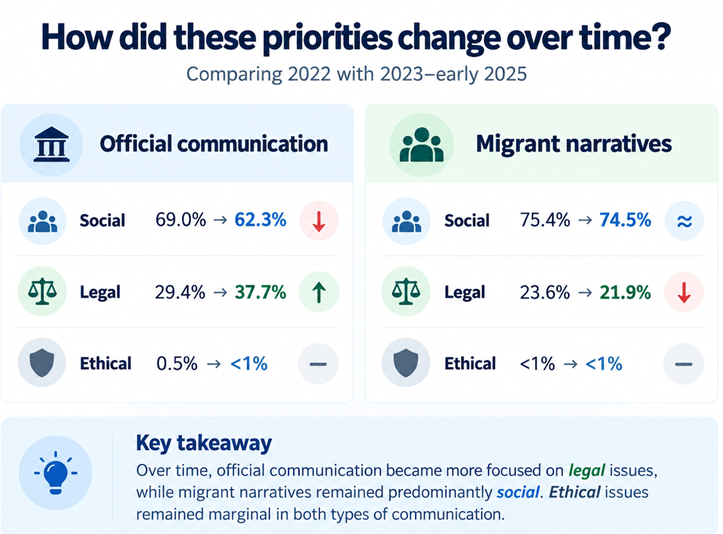
A further finding is that ethical issues were barely visible in either type of communication: about 0.3% of texts in each dataset were classified as ethical. This does not necessarily mean that ethical concerns were absent. More often, they were embedded in discussions of legal rights, fairness, support, vulnerability and social inclusion, rather than expressed explicitly as ethical questions. Even so, their limited visibility suggests that ethical reflection remained less prominent than social and legal concerns in both official and migrant narratives.
Taken together, these findings reveal differences between official priorities and the everyday concerns of Ukrainian migrants. While government communication increasingly focused on legal and administrative matters, migrants continued to emphasise housing, employment, education and other practical challenges. At the same time, ethical concerns related to fairness, human rights and social inclusion remained less visible in both perspectives.
As the war continues and the prospects for safe return remain uncertain, many displaced Ukrainians may need to build their lives in European countries for years to come. Their successful integration will require not only legal protection and practical support, but also closer alignment between government priorities and migrants’ expectations. Importantly, this alignment should include shared ethical values, such as fairness, respect for human dignity and human rights, and social inclusion.
For European policymakers, this highlights the importance of listening directly to Ukrainian migrant communities. Responsible AI-based analysis of public discussions, combined with surveys and consultations, can help identify changing needs and differences across host countries, making integration policies more responsive.
Ultimately, listening to Ukrainian migrants should be a continuous part of integration policymaking, not just a response to a humanitarian emergency. Bringing government priorities closer to migrants’ everyday experiences and shared values can help strengthen trust, social inclusion and cohesion in European societies.
Further Reading
For more details on the research and findings presented in this blog, see our two publications:
- Khairova, N., et al. (2024). Understanding the Ukrainian Migrants Challenges in the EU: A Topic Modeling Approach. Proceedings of the 25th Annual International Conference on Digital Government Research, 196–205.
- Khairova, N., Redozub, I., Dignum, V., & Rizun, N. (2026). Evaluating Generative AI for Identifying Ethical, Legal, and Social Dimensions in Migration Narratives: A Case Study of Ukrainian Discourse. Social Sciences, 15(6), 341.